Friday, June 15, 2012

Done Farmin'


I finally finished a job that should have been accomplished a month ago – the seeding of a small plot of hay just below the house.

Production on this field had been falling over the last few years as the alfalfa died out, leaving only poorly-producing grasses.  This is a normal occurrence, and is the reason that hayfields must be plowed up and re-seeded every 7-10 years.

I had tried a new technique: rather than use a mold-board plow to turn strips of sod upside-down, I had sprayed out the grasses and burned them off, then pulled through with a chisel plow followed by a duck-foot plow to break up the roots and soil.  It seemed to have worked well, and I followed up by pulling the leveler across the field before reseeding.

Chisel Plow

I tried a new technique there also.  Instead of waiting until spring, I had drilled in the hayseed along with winter wheat last fall, with the intent of having that new crop already up and growing this spring during the time when it normally too wet to farm.

Didn’t work.  The field was overcome by weeds, and the fall planting of alfalfa emerged only sparsely under the dense canopy.  I plowed it all under and started afresh.

It’s a small field, and only takes a couple of hours to cover, but it took a number of trips over the field, and almost-daily rain showers continually delayed the process.

The first pass was with the duckfoot.  But it left streaks of green weeds in the field requiring another pass cross-wise, and then another at a different angle again.  Then a pass with the disc to smooth out all the clods.  Finally I hit it with the leveler – again with three passes:  first north-south, then east-west, and finally at a 45o angle across that.
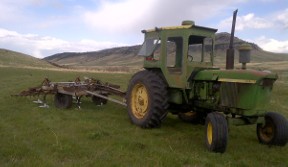
Duck-foot Plow
 
 It seemed as if every pass was followed by a rain shower.  Most of these showers contained enough moisture only to delay the farming process for another day or two, while not really adding anything significant to the soil moisture profile.

Then the drilling.  That should have taken only another couple of hours, but I ran short of seed and had to make a trip to town for another bag of alfalfa.  And then it rained before I finished.  

Drill Seeder

I was really puzzled by the amount of alfalfa seed I was burning through - until I looked again at the drill setting table:  I had read it to say that I needed a setting of 14 to get 4 pounds per acre, whereas a setting of 4 would deliver 14 pounds per acre!


But we’ve done all the farming we can do for awhile, and now we’re on to other tasks.

Saturday, June 9, 2012

Sloppy Saturday


It’s raining.  Not a real rain, but a steady patter – there was a half inch in the gauge this morning.

It takes a full four inches of rain to soak the soil to the depth of the roots, so these showers are akin to making the minimum payment on your credit card rather than paying off the balance – but we’ll take it!

Because the soil is not being soaked by Mother Nature we have been making up the deficit by irrigating our best hayfields.  Our first task every morning and last task every evening is to reset the water in the two fields.

One of the fields is irrigated by siphon tubes.  We have ten of these 3” PVC tubes that we pull out and reset on down the ditch.


To restart them we put them in the ditch to fill, then use a small ball to seal off the end as we pull them up and over the ditch-bank.

The other field has gated pipe.  We simply slide the gates open on another run of pipe, then close the gates that have been running for the last 12 hours.


I began the week by turning the bulls into the cows.  That subject is covered in my post from last year at this time - http://mellinniumcowboy.blogspot.com/2011/06/turn-em-in.html .  That project, of course, required the use of a horse. 
The bulls were in with a handful of dry cows, which had to be cut out.  I also had to cut out the one yearling bull that would be put in with the yearling heifers.  Then the two groups – bulls to the cows, one bull and the dry cows to the field with the heifers – had to be moved from ahorseback.

We had fencing to do:  Much of the fence up in our summer range was constructed some 80 years ago.  The wire is old and brittle, the original posts are all long rotted away, and now the replacement posts are falling over.

We had farming to do:  It finally dried out enough to disc and level another field, and to run the packer over the field where a new crop of oats has now emerged.

And more spraying:  I got off another 100-gallon load with the tractor, which jets a pattern 60’ wide and is excellent for getting the weeds along the rocky ridges.  I also spot-sprayed a couple of back-pack loads.

I didn't finish seeding that last field - and it will be a few more days now.  But I have plenty of desk-work to do, writing and paying the first-of-the-month bills.

Wait a minute.  It’s stopped raining.  The sun is shining!  Were back to plan A:  saddle up right after lunch to gather all the cows out of the desert and push them over the hill into the Schweiger.

Wednesday, May 30, 2012

In Memoriam


(WRONG: MEMORIUM. RIGHT: MEMORIAM. The correct spelling of the Latin phrase is “in memoriam.” public.wsu.edu/~brians/errors/memorium.html)

Many folks look forward to the Memorial Day weekend to escape the city and get out into the fresh air where they can enjoy camping and barbecue.  Not so for Montana ranchers. We are usually in the midst of farming and irrigating, and can’t afford the time away from the ranch.  But weather that has been slightly worse than “usual” allowed me a couple of days down country.

The past week at the ranch has been a bit frustrating.  Our priority continues to be completing the farming, but recurring showers have postponed that work indefinitely.  I did get the oats seeded in the new breaking up west, and some rocks picked.  And we did get the big leak in the north ditch sealed up.  I didn’t get to run the packer across the new seeding, however, and we didn’t get anything done more done than discing the field below the house that we still have to level and seed.

We had started irrigating in our two best hayfields despite the showers - which were only enough to shut down field work but not enough to nourish a good hay crop.  By Friday there was snow, and it became just too miserable to be dipping ones hands in the irrigation ditch to change siphon tubes, so we shut the water down for a few days. 

The wet weather at last gave us the opportunity to tear into the pickup we have been using for feeding for the last couple of years.  It had been displaying symptoms of both excessive carbon deposits in the heads, and of a blown head gasket.  So Ted began the task of removing the cylinder heads.  After hours of labor, however, he gave up in disgust.  Even in this old 1985 pickup there were so many tubes, hoses, and wires that he became overwhelmed.
With my encouragement he began anew, slowly disconnecting one tube after another, pitching redundant pieces out onto the ground. After another half day of work, he was able to dig down to the engine itself and remove the manifolds and heads.  We’ll begin reassembly another day.


I bought a new tool for the ranch this spring: a used “side-by-side” ATV that combines the characteristics of the four-wheelers that are now ubiquitous in ranch country with two seats and a box similar to a miniature pickup.  
As we had assumed when we bought the outfit, we use it all day every day for every job on the ranch: checking cattle, feeding small groups of animals, putting out salt, fencing, irrigating, transportation to the farming equipment….
But after two short months it has already fallen victim to West Boulder rocks.  We were checking for poison weeds in an upper field and caught a wheel on a rock buried in the grass.  We limped home with it, where we did our diagnostics: a hammered steering rack & pinion.  Parts are on order.

A newcomer to the area had expressed surprise at the kind of nasty weather we were experiencing this late in May.  That prompted me to visit my blog archives.  Posted for Memorial Day last year was a picture of a snow-level just above the ranch headquarters – just as there was this year!
The main difference is that we had a heavier snowpack last year, so we hadn’t yet been irrigating.  And in fact we didn’t irrigate until July last year, but rather spent most of time between rainstorms in June hauling rocks and dirt to fill gashes in the road left by a torrent of snowmelt. (See  Deluge & Hauling Rocks)

We have water in our ditches again now, and are midway through irrigating our two best hay fields – working on equipment in the shop between sets.


Monday, May 28, 2012

Reset the Clock


This is our busiest time of year – everything needs to be done at once, and every day that we delay in accomplishing each job will cost us in the end.

We have farming to do:
There are fields that need to be worked and seeded.  The earlier that we get the seed into the ground, the better crop we will get.  And the plants need to get their roots down while there is still good spring moisture near the surface, so that when the hot days come they are able to reach down further in the soil as that moisture recedes.

We have irrigating to do:
It’s been a dry winter and spring.  We want to fill the soil moisture profile in the hayfields before the plants get taller and demand more moisture to keep growing.  If those plants run out of moisture, they will go dormant and quit growing – resulting in a diminished hay crop.
But before we can start irrigating we had to repair the leak in the north ditch with several dumptruck loads of dirt, and replace several sections of gated pipe that shattered during the sub-zero temps.

We have fencing to do:
We had to repair the border fence in the first field into which we turned out cows.  We’ll rotate rapidly through all the pastures – once a week through June – so need to repair all the damage from wind, snow, and elk, to 25 miles of fence before we turn cattle in.

We have weeds to spray:
The hound’s tongue and thistle are coming on quickly in the field in which we held the pairs for the last month.  Of necessity, it gets over-grazed for that period when the grass is just starting to grow, but before it is ready to graze. 
In years past we have spent a lot of time controlling the poison larkspur that had been a problem in the upper pastures.  That has allowed us to get off the river bottoms and up on the mountain earlier in the summer, and ending overgrazing down below. 
But weed control is a never-ending task:  If you ever back off, the weeds will get ahead of you, and it will take years more to catch up.

For awhile the weather was warm and dry, and we were hurrying to accomplish as many of those tasks as possible.  This week the weather is cool and wet.  That puts a kink in accomplishing most of the above projects.
But at the same time, that cool, wet weather slows down the need to get them done. 

The fields aren’t drying out, and the weeds aren’t growing so fast. And thus our desperate need to beat the clock with farming, irrigating, and spraying.  Our clock is stopped for the duration of the rain,
               and it resets again when the sun comes out.

Tuesday, May 15, 2012

Branding 2012


The weather was looking good, and the calves were getting big.  I decided to brand on Saturday May 12.

The first two calls I made were to my son-out-law Phil, and his brother Darin.  These two are top-notch stockmen, and I had depended on their help for years.  We three had made the basis for a Ranch Rodeo team at Wilsall for some 7 years running, and had taken 2nd place in 2008 among 40 of the best hands in the ranch country of Park County.  They were clear, so I made a number of other calls to round out the crew.

I figured that we would need three ropers, a brander, two vaccinators, and six wrestlers.  Phil, Darin, and I could swap off roping/branding, but we would need at least one more good hand to alternate with us.  And it’s always better to have one experienced cattleman to spare for coaching wrestlers and handle contingencies.

In big ranch country there are plenty of neighbors with whom to trade help.  But most of our neighbors now are “gentleman” ranchers, and the rest have quit roping and gone to using a calf table to brand.  I was depending on friends from down-country for help.

Several of the stockmen I called had other commitments, and I was starting to get a little worried about crew.  I had my son Ted for sure, his buddy Shane, my neighbor Brian, and my Nephew Todd.  Along with Phil and Darin and their kids we could get by, but it might be more like work than we would like.

Ted had some friends from Bozeman, however, and they chose that weekend to celebrate Ted’s birthday with a camp-out along the river.  Most of them would be of marginal value, but there were a couple that might be good help.  I scored two other cowmen to help, and we were in business.

Gathering the cows from the pasture is an easy task, but a real adventure for some folks, and there is always too much help for that part.  Robert asked if the cows would cross the bridge alright, and I said “yes – if no one crowds them”.

I was still setting up equipment in the corral when the cows hit the bridge.  I heard more hollering than was useful, and soon saw cattle and horses running across the field the wrong way.  Someone must have crowded them!

I mounted my horse and crossed the bridge while the cows were scattering and joined the effort to gather them again.  I was told that one of the town dogs had been on the bridge when they tried to cross the first time, but that he was now tied safely to a post.

On the second go at the bridge it was a bull that held things up.  He stopped on the bridge and turned back at the herd, bellowing his belligerence.  I pushed through the herd and took the bull into the corral – it wasn’t long before the cows were coming across the bridge.

The cows don’t associate corrals with anything nice, and it took some pushing to get them through the gate.  Then we began sorting the cows away from their calves and pushing them down the alley and up the chute to receive their annual vaccinations for a couple of reproductive diseases, a couple of respiratory diseases, and a couple of intestinal diseases.

By noon we had the cows all worked, and were ready to quench our thirst at the beer keg and have some lunch.  Kathi brought sandwiches down to the corral, and we ate under a clear blue sky.

My grandson Toby and his cousin Justin wanted to do the vaccinating, so I designated their older sisters to monitor.  When the irons were hot I sent in three ropers.

Soon the calves were coming out as fast as I could brand them.  I didn’t have time to look around to appraise the wrestling, but I did notice that Darin’s son Cody and Ted’s girlfriend Julia were doing an excellent job.  My granddaughter Taylor handled her share, as well as some of the Bozeman crowd.  Soon a fourth roper went in.

Each of the ropers was attempting to snare both hind feet.  Unless one foot kicked out of the loop, a single wrestler could hold the front of the calf, with the roper still dallied to the hind feet.

After an hour one of the ropers came out and took over the branding so I could rope.  Again I was so busy I didn’t have time to look around, and the next hour went quickly.  Two hours after we began branding, the last calf was drug to the fire.

The whole event had gone very smoothly, and it was a delightful day - a fun time for everyone. The calves were soon back with their mothers and headed back out to pasture - and we were finished for another year.